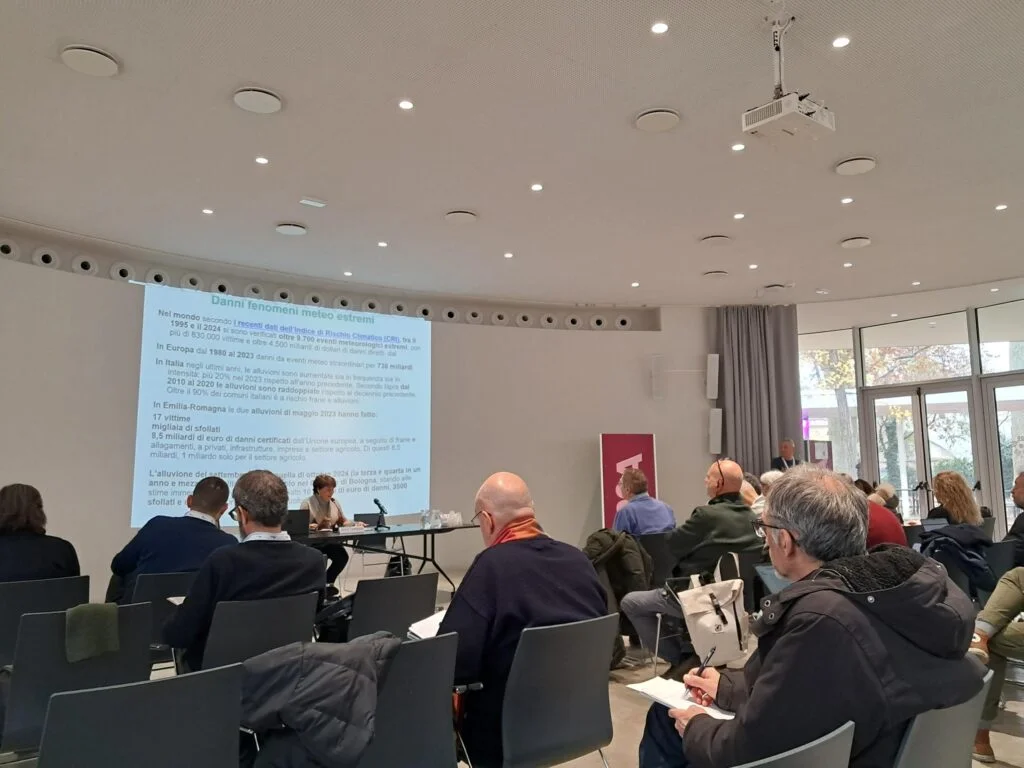
On 4 December 2025, the Third BauNOW Hackathon took place at Auditorium Filla in Bologna, bringing together 51 participants onsite and 692 viewers via Facebook livestream. The event concluded the BauNOW hackathon cycle (following the sessions on 26 June and 2 October 2025), designed to strengthen capacity-building and stakeholder engagement within the Interreg Euro-MED project “BauNOW – New Business as Usual”, with Kyoto Club as the Italian partner.
The final hackathon focused on “Finance supporting the climate and environmental transition”, highlighting how financial instruments, governance models, and cooperation between public and private actors can accelerate a Green and Just Transition toward climate resilience. The programme fostered dialogue among professionals, students, innovators, institutional representatives and other local stakeholders, and was organised in collaboration with the Fondazione IU Rusconi Ghigi.
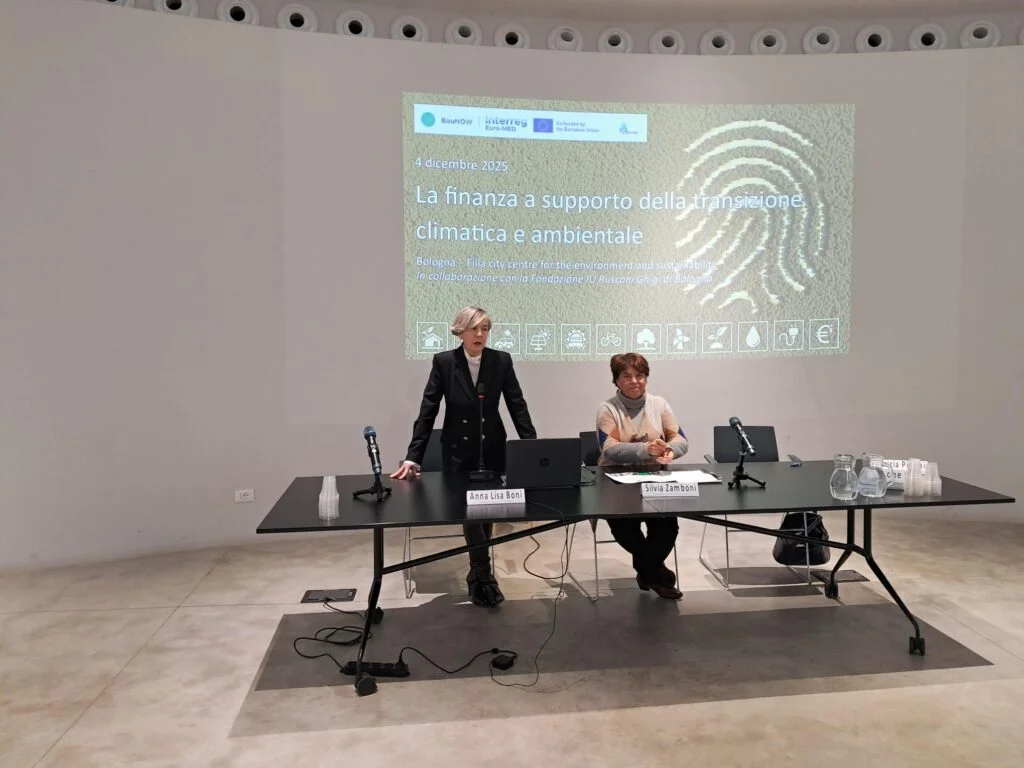
The morning session opened with institutional greetings from Anna Lisa Boni, Deputy Mayor of Bologna, who emphasised the financial “elephant in the room” of the ecological transition and highlighted the need to mobilise broad territorial partnerships. She also presented Bologna’s work under the EU Mission “100 Climate-Neutral and Smart Cities by 2030”, including the city’s Climate City Contract (currently involving 109 partners) and the scale of investment needs estimated at €11 billion.
Kyoto Club’s BauNOW Project Manager Silvia Zamboni stressed that finance is essential for enabling a Green and Just Transition and for overcoming “business as usual” approaches. She pointed to the importance of building decision-makers’ capacity to plan, implement and fund mitigation and adaptation measures, and introduced the Green and Just Transition (GJT) Dashboard as a tool supporting more effective climate investment decisions.
Key insights on sustainable finance and risk management were further developed through contributions from ESG experts and banking representatives, who discussed how banks and investment funds are integrating ESG criteria, addressing physical and transition risks, and designing financial products for companies and communities. Speakers also underlined persistent barriers—especially for SMEs—including uncertainty, regulatory complexity and information gaps, and highlighted the need for clearer frameworks, financial education and stable policy signals.
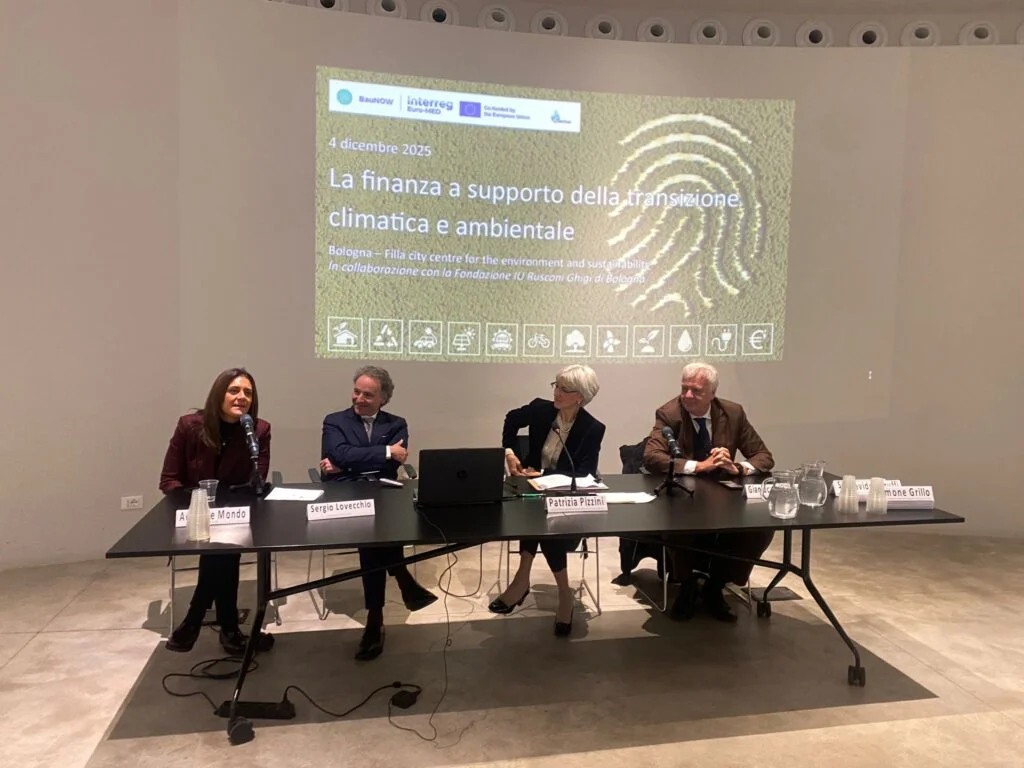
In the afternoon, the focus shifted to replicable financial models and practical instruments, including ethical and impact-oriented finance, simplified sustainability reporting pathways for SMEs, and integrated solutions that combine incentives and private capital to reduce upfront investment costs.
Overall, the Third BauNOW Hackathon confirmed that financing the Green and Just Transition requires coordination across public policy, financial instruments and engaged stakeholders. The discussions highlighted the importance of regulatory stability, innovation and cooperation to mobilise investment and turn the transition into a driver of resilience, competitiveness and social cohesion.
All presentations and the event recording (in Italian) are available here: link